This is a raw one — discretion advised

“What is a merciful heart? It is a heart on fire for the whole of creation—for humanity, for the birds, for the animals, and for every created thing.”
— St Isaac the Syrian

The last five years, the process of recovery—or more to the point, the healing grace of God—has been at work in me. The painful process of accountability and consequence made the anaesthetic of ignorance wear off. They say ignorance is bliss; to me, it was a numbing effect that reduced me to sub-human levels of empathy. Sexual objectification leads to the dehumanising of others and self. Believe me, I know.

I’ve written in my manuscript for a book I’m working on about how there is plenty of good in the world and plenty of evil, and how we do depends greatly on our point of view. From time to time, however, the world throws a story our way, much like the papers that used to get flung into someone’s front garden. Every now and then, one lands that you can’t just pick up and throw away.

As someone with two spaniels, and without huge scientific intervention unable to father my own kids—and probably too old now anyway—our dogs are our kids. Our first dog came as a bundle of fluff at eight weeks old, just days after the bottom fell out of my life. Just a week before, my partner held her for the first time and her eyes lit up with the closest thing to maternal excitement I’ve ever known.

At a time when taking things a day at a time was just too much, I had to go hour by hour. A puppy will do that to you. This little puppy kept us present and gave us hope and joy at a time when so much was up in the air. I had hit our relationship with the bombshell revelation that I had been living a double life and suffering with pornography since I was barely 12 years old. I mean no cliché when I say that little puppy, now five years old, saved me and continues to. Now accompanied by her little companion, who is two, they have both shown me what unconditional love is and that it can be expressed without uttering a word.

It is with that context that the viral story of a little street dog named Wang Wang hit me this week like a brick in the head. Four youths in a Chinese village reportedly beat and tortured her three puppies, just two weeks old, to death, and after beating and torturing her, set fire to her—all while streaming and filming it like it was fun.

I saw some clips that I couldn’t watch, and the snippets I did see haunt me. I cannot get them out of my head. I’ve recently become vegetarian to join my partner, so between us we are very animal-rights driven in our worldview, but this went somewhere beyond that. This subject has presented me with an anger and pain that aren’t personally mine, but a sense of needing justice rages within me.

Another thing at work is shame. I spent years degrading fellow humans as objects, and I despise that part of me. That part has been healed and transformed, but the memory of it remains, and seeing the capacity for dehumanisation in others is a bitter taste to hold in one’s mouth. I’m not comparing what I did with what was done to this dog and her puppies, but I do recognise something about what happens when empathy becomes numb and another living being becomes an object rather than someone or something of value.

So let’s work through this. I cannot wish some sort of damnation on those young lads who thought that this evil deed was somehow a good idea. I need to remember that if me, undeserving of grace, gets grace, then who am I to judge and damn someone else? But this doesn’t let them off the hook. What they did was evil. Justice and accountability still matter. I just need to let myself off this hook of resentment. That’s what’s at work here.

I hated the act of evil done to this precious little soul and her babies. There’s also fear in there because I love mine so much that the thought of losing them—which for almost all dog owners is an inevitability—is almost unbearable. Perhaps seeing something so vulnerable treated with such cruelty touches that fear too. We love these little creatures knowing that, in all likelihood, one day we will have to say goodbye to them, and there is something terrifying about loving anything that much.

When things happen that crush us and give us a worldview of pain and hopelessness, it’s specifically at this moment that I wrestle with my faith. I always used to scratch my head about Jacob wrestling with God, but I think I understand it more now. That’s what happens when we filter what we see in the world through the lens of a loving God whose ways are not our ways. Sometimes what we see and what we believe about God simply don’t seem to fit together, and so we wrestle.

If I let someone look at the black and white of my darkest decisions, then I’m sure plenty would damn me just as part of me wishes to damn those boys. This is where most of my wrestling with God leads—to the willingness to let go and let God. Not to pretend what happened wasn’t evil, not to say there shouldn’t be consequences, and certainly not to make what happened okay. But if I, undeserving of grace, get grace, I don’t then get to stand at the gates of that grace deciding who else is allowed through.

That’s uncomfortable because grace is easy to believe in when we’re talking about ourselves or people whose brokenness we understand. It becomes something altogether different when we’re confronted with someone whose actions disgust us. That’s where I find out whether I actually believe what I say I believe—that grace isn’t something earned by deserving people, and that the darkest thing a human being has done does not get the final word on who they are or what God can do with them.

China has a particularly bad history with the treatment of animals, and I guess that’s a cause, along with the numerous charities that work with street dogs, that I would like to fundraise for in the future. That’s the only thing I think I can do—to be a part of the change I long for rather than simply sitting with anger about something I cannot change.

I can’t undo what happened to Wang Wang and her babies, and I can’t unsee the little that I saw. But perhaps I can decide what I do with the fact that it affected me. Maybe the answer to feeling helpless in the face of cruelty is to turn some of that pain into compassion and action somewhere else.

Maybe that’s part of recovery too. When the anaesthetic of ignorance wears off, you start feeling things again, and sometimes feeling things fucking hurts. The answer isn’t to find another anaesthetic. It’s learning what to do with what you feel.

So when I get home tonight, my little dogs are having extra cuddles.

Whether they want them or not.

Please sign the petition

https://www.change.org/p/the-tragedy-innocent-animal-lives-destroyed

Lead me not into temptation

Over five years into recovery, my connection to SAA is minimal. I recently attended a very dear friend’s celebration of life and saw some faces I hadn’t seen for a while. It reminded me that I have needed to share some perspectives during this time, especially for those who may have some miles on the clock and find themselves a little disconnected from a previous chapter, when recovery was exciting, and who now feel in some sort of no-man’s-land.

I’m about two years on from regular sit-downs with my therapist; at one point, I used to go weekly. I’m also two years on from being at a meeting every week and having a week dominated by service calls and sponsorship.

Now my phone rings less often, and sponsees reach out less and less. I have a weekly meeting with guys who share my faith and approach life with vulnerability and honesty. In that regard, we are like a recovery group, and this outlet allows me to fulfil my ongoing programme of recovery. I continue to take inventory (Step Ten), maintain my conscious contact with God (Step Eleven), and carry the message of recovery by living more authentically (Step Twelve), so why do I feel like I’ve fallen back somewhat?

My honest answer? Long-term recovery, and living life on life’s terms, is at times a permanent reminder that my life derailed. There are closed chapters, lost friends, closed opportunities, and shut doors. My early zest and serenity made it easier to live with those realities—to accept the things I cannot change. I may have the wisdom to know the difference between the things I cannot change and the things I can, but it doesn’t mean the constant reminders don’t rob me of joy.

There is an element of recovery which feels like maintaining a constant state of self-awareness and effort to abstain, in thought and deed, from something which most guys don’t even think is an issue. I’ve never been someone who approaches recovery as living under a rock, and as a result, I would never coach someone to pursue a white-knuckle definition of sexual sobriety.

We have the Three Circles as a tool, and there’s a middle circle for that very reason: process addictions are not as binary as drink or don’t drink. Take a food addict—the answer isn’t to starve to death. In the same way, for the sex addict, the answer isn’t to chop your Johnson off and live like a eunuch Jedi.

All that being said, I’ve noticed bargaining and justification creeping into what I consider the grey zone—the middle circle of behaviour. I’m a boundary bender and, as such, I can push things on social media from time to time: lingering here and there on something in my feed, following the odd unhelpful account. I’m usually open about it and brush it off with the idea that, compared to where I used to be, I’m just orbiting harmless and innocuous stuff.

The problem with this approach is that the algorithm can become a dealer and a pusher. I wish there were an algorithm opt-out button, but here we are.

The screen-time stats on my phone show that, even in my much better life, my dependency on my phone is a time hole. If I’m honest, I can fall into scroll rabbit holes, and even my use of AI has become something I can waste time on. It can take me away from being present in my own life and leave me feeling a lot like the avoidance and medicating I used to get from acting out.

AI, if I am honest, has some pretty solid safeguards around image generation and nudity. I know that because I’ve found myself trying to push them, and that in itself is a form of relapse. But I believe that’s a spectrum, and let’s just say that in my five years, I’ve been on that spectrum in one way or another more than I would care to admit.

So what do I do about these things? Well, the answer is the same now as it was when I was plugged into SAA 24/7 and obsessed with recovery: honest reflection, continued willingness to be helped and to share, and being willing to make some changes. For instance, I now allow myself three hours a day with social media and AI, with a solid, enforced cut-off from night-time until late morning.

Long-term recovery is a little like maintaining a waistline: you are never going to weigh the same without some consistency, and your recovery will never stay as it was early on. Sure, there are some guys who, for years—decades even—attend every meeting like clockwork. It’s okay that my life has grown in other directions, but it’s not okay to be complacent and construct a self-deceptive narrative.

It’s why we need one another. Recovery is best worked in connection with others because, regardless of what the addiction is, isolation is the soil of addiction.

Victims and Perpetrators

I get triggered by Christians who can’t hold two things at the same time. I came across a thread about a grace and union centred podcast possibly having Russell Brand on. With everything going on around the allegations and the court case coming up, it’s stirred up a whirlwind of emotionally charged responses.

Let me be clear. I’m fairly progressive and left leaning. My respect for Brand comes from the recovery space not necessarily his journey into Christianity or his politics.

I’m not defending him as a fanboy. I simply wish him well as a fellow addict in recovery and obviously a fellow man carrying regrets over behaviours of years gone by.

A lot of the responses focused on safety for survivors, saying that platforming him makes it no longer a safe space. I get that. I really do. But something in me got hit when I read it. That familiar feeling of, if they knew my story, I’d be written off too.

As he made an admission of having a sexual relationship with a 16 year old at 30, the disgust and rage of the comments struck me in my core. At 29, I slept with a 17 year old. For years, I wore that like a badge of honour, fuel for a toxic version of masculinity. I’ve also consumed pornography, including content shaped by exploitation and abuse. That’s part of my story. Not the whole of me, but it’s there. The immediate voice in my head. “I am scum”

As someone in recovery from sex addiction, and someone who leans hard into grace and restoration, it can feel like there’s no room for nuance when I see demands for the unforgivable ones to be thrown to the fire. I’ve felt that before and I’ll likely feel it again. We live in a culture that often wants to exile the perpetrator completely. Some sins are seen as beyond redemption.

But I believe God is for the healing of the victim and the redemption of the perpetrator at the same time. Not one or the other. Both. He doesn’t erase the past as if it never happened. He redeems it. He meets us in it and transforms what feels irredeemable.

The truth is, most of us carry both of these roles in different ways. Victim and perpetrator. Maybe not in the same measure or the same visibility, but the line is thinner than we like to admit.

I live with parts of my story that I don’t lead with. Not because I’m hiding, but because sharing that level of detail isn’t always wise or helpful. Sometimes it’s like pulling the pin on a grenade. There are places for that kind of honesty, and I’m grateful I have them.

A new friend of mine said, “Being honest isn’t the same as disclosure, but without honesty, there is no relationship”

And this is the tension. None of us fully knows what another person carries. The worst thing they’ve done. The harm they’ve survived. The work they’re doing to change.

For me, grace isn’t about minimising harm or bypassing justice. It’s about holding space for truth in all its weight. Naming what’s broken without pretending that redemption isn’t possible.

That’s not an easy place to stand. But it feels like the only honest one.

Paul Young’s The Shack has stayed with me for years because it refuses to resolve this tension neatly.

Mack is shaped by deep childhood abuse. That pain leads him, as a boy, to kill his own father. It’s a secret he buries for years until it is brought into the light and met by God, not with condemnation, but with healing.

In that story, Mack is both victim and perpetrator.

And then the tension deepens. He is also a grieving father, faced with the man who took his daughter, Missy. The story doesn’t offer easy answers or quick justice. Instead, it dares to explore the possibility of forgiveness in a place most of us would rather not go.

That’s why it stays with me.

Because it doesn’t flatten people into categories. It doesn’t pretend that the harm isn’t real. But it also doesn’t give up on redemption, even in the darkest places.

It holds the same tension I feel in my own story, and in the stories of others.

That somehow, grace can meet both the wounded and the one who wounds.

Not to excuse. Not to minimise.

But to redeem.

Reflections on Recovery – approaching five years

This year will mark my fifth year in recovery. I would say I have definitely encountered my psychic shift. It has all been by God’s grace, paired with a willingness to look in the mirror, talk honestly about the inside of my brain, and accept that I was never meant to do this alone.

What has changed recently? If I’m completely honest, my focus has shifted from recovery from to recovery to. I’ve used that phrase for the last couple of years because I knew I needed to move forward into life, shaped by this new way of seeing the world and my relationship to it.

I remain, in many ways, a walking paradox. I am many things at once. I am grateful and feel pangs of remorse on any given day. I wouldn’t change a thing, yet I would give anything for a do-over. These statements sound like they can’t exist in the same space at the same time, but who ever said the very being of a man is bound by the laws of physics?

The mantra of my recovery fellowship is from shame to grace. Many would read that as a point A to point B journey, and I suppose that’s partly true. What that view often misses is that we continue to need grace, and we continue to take inventory. In the Twelve Steps, the inventory begun in Steps 4 and 5 continues in Step 10. This is ongoing.

Every day in recovery is a spectrum of relapse into the illusion of independence. I may not fall back into my darkest hole, but each 24-hour period is still full of cocktails of fear, resentment, gratitude, peace, joy, and regret. I am a tapestry of what the programme calls assets and defects of character.

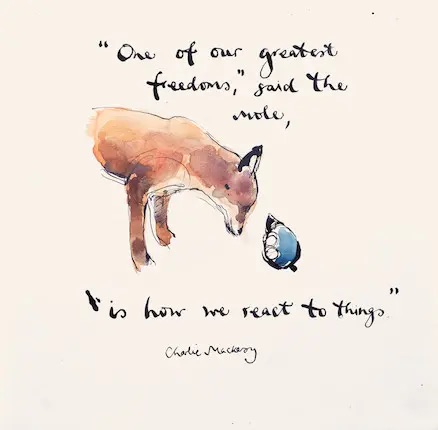
In The Boy, the Mole, the Fox and the Horse, the mole says to the boy that one of our greatest freedoms is how we react to things. Every day presents that opportunity to live in freedom. Until I accept that the only thing I can truly count on in this world is the grace of God, my inventory becomes that of a score-keeping Pharisee of self. With grace, it becomes a head-up, self-aware posture that recognises how a word, a look, or a deed affects others.

One of my biggest life skills is the ability to own my own shit before others do. I am still a smiling and loving pile of contrition. Honestly, the day I cease to be so is probably the day I fall back into my old delusions.

If my addiction is wedded to my illusory self, then I see it existing in much the same way Lord Voldemort endured throughout the Harry Potter films. My cycles of addiction split my soul into pieces, hidden away like horcruxes. For me, food, social media, tech doomscrolling, procrastination, and even permitted sexual behaviours can become places where my character defects feel nostalgic for the past.

Here’s a concrete example. Masturbation with the boundary of no porn or unfaithful fantasy is a permitted behaviour for me, yet I often need reining in. The muscle memory to ritualise it is deeply ingrained. With food, I can eat badly, gain weight, and quietly undo the wins of a life lived in recovery. My running, cold plunges, and hunger for outdoor adventure give way to eating at stupid times, buying larger clothes, and chewing Andrew’s antacids like they were named after me.

This week’s contradiction is this: I have desire and lust for my own partner. Instead of stepping out and initiating intimacy, I retreat into fantasy. I end up in another room, jacking off to imagination and euphoric recall of being with the woman I love. There’s something profoundly sad and lonely in admitting that I have all I need, yet still opt for a counterfeit sense of relief. I don’t feel overwhelming shame about it, but it continues to fuel a deep sadness.

When it comes to intimacy, I express love, affection, and longing. Yet years of feeling inadequate and fearing rejection pull me back into nostalgic fantasy, rather than the beautiful, participatory chaos of real connection. Call it what I want, but I’m living in the past, flicking through the “porn magazine” of my own biography.

Even here, there is gratitude. I long for her. I can honestly say I’ve never been so tethered in desire, love and fantasy to my own partner.

So what’s my feedback to myself? My recovery logic differs from that of an alcoholic, where sobriety is black and white: consume or abstain. That binary works for substance addiction. With process addictions, the reasoning is different. Food addicts still need to eat. Gamblers don’t need to gamble. Sex addicts don’t need to be celibate. The issue is discernment.

In SAA, we define our own abstinence. It isn’t fixed in stone, but it must be rooted in honesty. To thine own self be true.

This is why others remain essential to my recovery. I can’t afford to confuse privacy with secrecy the way I once did. Today, my self-reading tells me I am more emotionally open, reflective, and gracious. Yet I am still intimacy-avoidant, and I can’t change that alone or heal in a vacuum.

So nearly five years in recovery? It’s still one day at a time and my recovery is best done less about me and more about we.

This is where we talk , set another boundary and continue to take one day at a time.

God, give me the serenity. Grace always grace!

Honesty is Recovery Theology

“Only by discussing ourselves, holding nothing back, can we stay in fit spiritual condition.”

— Bill W. As Bill Sees It

Over the last year or two, my Step Eleven, “maintain conscious contact with God,” and Step Twelve, “carry the message to others,” have brought me to a new kind of crossroads. I’ve had to face my need for ecclesia — a spiritual community — in a way that the rooms of SAA, for all their grace and connection, couldn’t fully meet.

I remain part of my home group. The relationships I’ve built there will always be part of my life. I’ll never graduate from recovery, and I’ll always feel the pull of purpose to love and serve in that community. But alongside that, I’ve felt a growing need for fellowship with Jesus people — not in place of recovery, but as a continuation of it.

The Twelve Steps became my map, not only toward healthier living but toward a more gracious and loving vision of the God who still remains mystery. And if one thing has become clear, it’s that God is inexhaustibly loving, forgiving, and kind.

You might think that means I should simply find a church and settle in, and you’d be right — it should be that simple. In my naïveté, I thought I could find a quiet fellowship with a safe, non-triggering environment where I could participate and belong. I met with the minister, shared my story, and we reached a mutual understanding that healing and restoration could include me playing songs during worship.

But the level of disclosure that recovery brings can be a tightrope for some. I shared my full story with this dear brother and was met initially with grace, understanding, and accountability. Yet when my involvement was later reviewed with the wider leadership, we were met with knee-jerk concern and a hard “no.” The decision was made that someone with my sexual sin history could never be deemed trustworthy to serve out front.

To be treated like a potential public risk or dangerous deviant as a result of my transparency left me with a mix of forgiveness and resentment to wrestle through. I do understand the horizontal consequences that come with the chaos we create in addiction — the broken trust, the hurt, the long shadows. This isn’t a pity party or a refusal to own my past and my part.

But this experience taught me something else: that it’s safer to stay under my rock than to risk darkening the door of another “godly community.” My hope wasn’t about taking a stage; it was simply about being welcomed and allowed to participate. The Bible is full of broken people used by God — not because of their righteousness, but because their human brokenness became the very space where grace could shine.

I’ve seen crowds cheer as murderers testify how Jesus met them in prison, and I say yes and amen to that. Yet somehow my own moral failure, expressed through the isolation of internet use, placed me beyond restoration in the eyes of some. Sexual dysfunction carries the most shame and controversy, so it’s two for two.

Isn’t it strange that Twelve-Step recovery communities often demonstrate a deeper understanding of grace than many churches? That experience showed me that my calling lies not behind a pulpit, but in men’s ministry — sharing my once-unspeakable story with the men who sit silently in pews, carrying their shame in secret because the “Sunday best brigade” offers no safe place to speak.

I understand that churches face real challenges in the aftermath of #MeToo and countless historic safeguarding failures. But the cosmic shift of the Cross — the declaration that grace has been extended to all — seems at odds with closed doors and cynical suspicion. The Church was meant to be an ER for broken humans of every kind. If we doubt that, we need only look at the people Jesus sought out.

The great Robert Capon once said:

“Jesus did not come to cure the curable, to reform the reformable, or to teach the teachable. He came to raise the dead, and by raising the dead, to make the whole creation new.”

In Twelve-Step recovery I’ve met men from all walks of life, including ministry. Many found in those rooms the grace and warmth they never found in church — a space where weakness becomes the doorway to love. In a world that keeps shouting “do more, try harder, be better,” they find healing in surrender, not striving.

I believe we’re living in an age where the world is beginning to see that we are all addicts of one kind or another — a planet full of broken people chasing dopamine highs, validation, and isolation behind curated profiles and identities carved by trauma.

It’s time for the Church to become the sanctuary and refuge it was always meant to be — a place where honesty is theology and truth is our currency.

As for grace and forgiveness, they’re already on tap. The flow began two thousand years ago, and that barrel will never run dry. In Jesus, God really has done for us what we could never do for ourselves.

Stuck in the middle with me

“My advice is, never do to-morrow what you can do today. Procrastination is the thief of time. Collar him!” — Charles Dickens  

Anyone working the steps with SAA will know the terms inner circle, outer circle, and middle circle. It’s one of the first exercises in recovery—but this isn’t a post about defining the circles.

This is more about what long-term recovery actually looks like. I’ve been on this path for over four years now, and while I’d love to say I’m living in full serenity and the outer circle all the time, that would be insincere. Recovery takes honesty, and the truth is, I spend a fair bit of time in the middle circle.

Each person in SAA defines their own abstinence, but if we’re not careful, those definitions can turn into a game of musical chairs. The inner circle behaviours are usually the obvious destructive ones that caused the crisis that brought us into the rooms in the first place.

But the middle circle—that’s the messy in-between. These are the mind states and lifestyle patterns that don’t look like outright destruction but still pull us away from presence and connection. Life is full of responsibilities and distractions, and while distraction itself isn’t always bad, it can easily become destructive if we don’t have a foundation of support—through God, community, or honest relationships.

For me, the world is saturated with distractions. Political noise, religious arguments, artificial intelligence, endless short-form videos—scrolling a social feed alone can be enough to depress anyone or drag them into a rabbit hole. The best advice? Pause, and switch course.

I regularly prune my feeds, hitting the three dots and selecting “not interested.” It’s part of staying a healthy human as much as it is about recovery from pornography. My phone greys out most apps at midnight until 8 a.m., but I still find myself burning through my screen time allowance long before the cut-off.

Sometimes I binge YouTube all day, procrastinating on things that actually matter. I may not be a gamer, but I can be just as avoidant.

The middle circle is, for me, often about life avoidance. I can lose hours doom-scrolling political misery or watching other people’s adventures instead of making my own. Even bingeing podcasts and recovery content can keep me from actually showing up in my own life.

Sexually, the middle circle often means navigating solo behaviours. These are awkward but necessary conversations—whether with a sponsor, a friend, or my partner. With my partner, we talk openly about what’s healthy: frequency of masturbation, what fantasies are grounded in reality.

Privacy in my sexual life once bound me in secrecy, shame, and isolation. Now, it’s about honesty. The healthiest place for sex is with my partner, in the outer circle, and that’s a two-way street.

From time to time, I catch myself doom-scrolling into subtle objectification. I tell myself, “I’ll just follow that account—it’s harmless.” But fantasy has to stay grounded in reality. Having a tent in my pants over my partner is fine. Inviting Hollywood actresses to the party? That’s just mixing a stronger cocktail for my little pants party and that’s not something I want to be normalising.

The middle circle is where boundaries get nudged. That’s where Step Ten—and plain common sense—kick in. Reflect, check your thinking, and keep the lights on. Secrecy always alienated me, so I choose to live openly.

I also try to go first in these conversations with the men I co-sponsor. Recovery isn’t hierarchical; we walk side by side. Recently I shared about buying a male sex toy, just to experiment with sensation rather than the lifetime reliance on visual arousal. I use humour in those conversations to take the heat out of it, because these are things worth talking about.

The middle circle isn’t a campsite—it’s a crossing. And it’s always best crossed in company, through honest conversation with a friend.

Because recovery isn’t just about what we’re recovering from. It’s about what we’re recovering to.

Toxic Virtuosity

“If you want peace, you don’t talk to your friends. You talk to your enemies.” — Desmond Tutu

I come from the dissenting left. Not the Instagram left or the Twitter hashtag left, but the historic, working-class, trade union labour movement — the left of picket lines, miners’ strikes, and the Tolpuddle Martyrs. The left that fought for the vote, for wages, for dignity. That strand of British politics has always been rooted in the simple conviction that the wealth of our economy should be distributed among all levels of society, and that ordinary people should have the freedom to live without being hemmed in, blocked, or diminished by systems of exploitation.

That’s the DNA I inherited. And when I left evangelicalism, I found myself drawn into that heritage through the writings of Tony Benn. Benn connected me with a new sense of identity. Politics, for me, became what faith had been: a moral compass, a cause greater than myself, something to believe in and to fight for.

But here’s the truth: politics became my new religion.

Around the time of Brexit, through to the 2019 election, I threw myself into left-wing politics with a kind of religious zeal. I was radically enthused, mobilised, and consumed by it. Looking back, it was unhealthy.

At the time, I was still in my addiction, still living with deep fractures between who I was in public and who I was in private. Politics gave me a new mask to wear. In public, I projected a virtuous version of myself: righteous, loud, uncompromising. I found others who projected the same noise, and together we created what looked like a new kind of church.

But inside, in the mirror, I was suffering. Alone, I was broken, caught up in secrecy and shame. Politics gave me a pulpit and an audience, but it was all a performance.

Today I approach politics through a very different lens: the lens of my own recovery and faith. When I discuss principles, I begin with humility. I begin with the awareness that I am flawed, limited, and imperfect.

And it’s that humility that seems to have disappeared from politics. In its place, we see something else: what I call toxic virtuosity.

Virtuosity in this context should mean performed with excellence, virtuousness meaning having moral integrity, and courage. But toxic virtuosity is when the pursuit of the moral high ground becomes poisonous. When virtue is no longer about justice or compassion, but about projection — an eloquent performance of righteousness that actually dehumanises the opponent.

We see it in the way algorithms reward outrage. The louder you shout, the more you’re seen. The more uncompromising you appear, the more virtuous you look. Outrage has become currency in the attention economy, and politics has been reduced to the theatre of moral performance.

A case in point: The assassination of Charlie Kirk.

Now, let me be clear: I probably disagreed with Kirk on virtually everything. Theologically, politically, socially, we would not have shared common ground. I don’t think we would have even agreed on what the gospel is.

And yet, in the wake of his murder, what I saw on the left disturbed me more deeply than the reaction of the right.

People were celebrating. People mocking. People are revelling in his death. And these weren’t fringe voices; many were people who would otherwise claim to represent compassion, equality, and humanity.

The mask slipped. The virtuous facade revealed itself as toxic.

Because in that moment, it wasn’t about theology or politics or ideology. It was about a man — a father, a husband — brutally killed. A family left behind. And instead of lament, we saw glee.

That’s not virtue. That’s poison.

Step back and you see the same dehumanisation at a global level.

We live in a time when war economies drive political systems more than human lives do. Where presidents can hoodwink whole movements — including Western evangelicalism — into becoming cheerleaders for atrocities. Where Zionism is sanctified, and suffering neighbours are demonised. Where genocide plays out on our screens, and the response is hashtags and tribal slogans.

Politics has always been about power. But it was also once about consensus, about the building of a common good. Now it is about platforms of influence, outrage and algorithms. And the result? Othering, labelling, hatred, vitriol, threats, violence, assassination, murder.

This isn’t a left thing or a right thing. This is a human thing.

So what does it mean to bring humanity back into politics?

For me, it begins with humility. By recognising that I am not virtuous in myself. That I am flawed, and so are you. That politics should never be about masking our brokenness with outrage, but about meeting one another as human beings first.

When politics forgets to be human, it becomes toxic.

The answer isn’t to abandon principle. I still hold to the principles of the dissenting left — solidarity, justice, the fair distribution of wealth and power. But those principles must be rooted in humanity, or they become hollow.

There is nothing in mankind that is fully virtuous. We are broken, flawed, selfish, arrogant. And when we forget that, when we build political identities that mask it, we slip into toxic virtuosity.

But there is one. One who embodied humility. One who did not seek a platform but washed feet. One who bore the violence and hatred of politics and empire and yet responded with forgiveness.

The story of Jesus is not just a religious story. It is a story about humanity. A story about reconciliation. A love story that breaks through the toxic virtuosity of human politics.

And I wonder — in an age of wars, assassinations, and outrage — whether that is the story we most need to hear.

The 12 steps and 12 traditions would mean I shy away from commenting on outside issues, but away from the rooms I live in, the outside world.

That world is still suffering, and it needs a message

Para-Socially Detached

“Connection is why we’re here. We are hardwired to connect with others — it’s what gives purpose and meaning to our lives.” – Brené Brown

In recovery, many of us come to understand the four main attachment styles through the lens of psychology — secure, anxious, avoidant, and disorganised. They’ve helped us make sense of our relationship struggles, emotional wiring, and the ways we engage with fear, intimacy, and connection.

The theory of attachment began with John Bowlby, a British psychoanalyst who proposed that early relationships with caregivers shape how we relate to others throughout life. Mary Ainsworth later expanded this research with the famous “Strange Situation” study, identifying patterns in how children seek and maintain proximity to caregivers — patterns that echo into adulthood.

Here’s a brief overview:

1. Secure Attachment

Formed through consistent, attuned caregiving. Adults tend to build balanced relationships marked by trust, communication, and emotional safety.

2. Anxious Attachment (Preoccupied)

Develops from inconsistent caregiving — love is present, but unpredictable. Adults may crave intimacy, fear abandonment, and seek constant reassurance.

3. Avoidant Attachment (Dismissive)

Arises when a caregiver is emotionally unavailable or dismissive. Adults often downplay their needs and avoid emotional closeness, prizing self-sufficiency.

4. Disorganised Attachment (Fearful-Avoidant)

Often rooted in trauma or neglect. Adults may desire connection but simultaneously fear it, resulting in chaotic or push-pull dynamics.

These styles are incredibly helpful — but I believe something new is emerging. A pattern that doesn’t originate in the nursery, but in algorithm-driven culture. In the absence of a formal psychological category, I call it para-social detachment.

What Is Para-Social Detachment?

A para-social relationship is one-sided. You feel emotionally invested, but the person on the other side — a YouTuber, celebrity, porn performer, or influencer — doesn’t know you exist. It scratches a certain emotional itch. But it asks nothing of you. You can feel connection without ever risking vulnerability.

The para-social detached person often presents as independent, high-functioning, and confident. But underneath, they may have few mutual, emotionally deep relationships. Instead, they’ve outsourced emotional connection to curated media channels, personalities, or imagined relationships.

We all do this to some degree — it’s part of the modern human condition. But for some, it becomes the primary relational posture. I see it behind the bar where I work: people scrolling instead of speaking, couples together but miles apart, lone drinkers more engaged with a streamer than the humans next to them.

And I’ve been that guy too.

Traits of Para-Social Detachment

Emotional Outsourcing: Relying on influencers, creators, or parasocial “relationships” to feel emotionally soothed or stimulated.

Curated Identity: Projecting a version of self online while avoiding vulnerability in real life.

Low Relational Depth: Few deep, reciprocal friendships or emotionally intimate bonds offline.

Fantasy Over Risk: Preferring imagined or controlled connection to the messiness of mutual relationships.

Digital Numbing: Using screens, porn, or endless scrolling to manage mood or avoid discomfort.

Controlled Connection: Avoiding emotional unpredictability because performance feels safer than presence.

This isn’t isolation by circumstance. It’s isolation by design — a subtle self-protection masked as autonomy.


This isn’t just about screen time. It’s about how digital culture has shaped our nervous systems, rewired our brains, and taught us to expect connection without risk.

When real-world relationships have felt unsafe, overwhelming, or unfulfilling, para-social detachment can seem like relief. No one argues with you. No one lets you down. No one leaves. But that curated safety become a prison. And what once protected us begins to isolate us.

Healing the Para-Social Detachment

You’re not broken. You’re not bad at being human. You’ve adapted — brilliantly — to a world that rewards surface over substance.

But healing is possible.

Here’s what it might look like:

Name It – Be honest with yourself. How much of your connection is one-sided or curated? Get Real, Not Just Raw – Vulnerability isn’t about oversharing online. It’s about showing up in messy, mutual, offline relationships. Reclaim Human Spaces – Prioritise environments where you can’t control the outcome: recovery groups, shared meals, long walks, awkward chats. Detox Slowly – Not to punish yourself, but to pursue something deeper. Unplug to plug in. Build New Habits of Presence – Eye contact. Silence. Being interruptible. Sitting in discomfort without reaching for the scroll.

You don’t need more followers.

You need friends who’ve seen the basement of your soul — and still want to sit down there with you for a cuppa.

The para-social world might soothe our loneliness — but it can’t heal it. That starts when we stop mistaking projection for connection.

We don’t heal alone.

We heal in eye contact.

In shared silence.

In imperfect, mutual, embodied relationships.

If this lands uncomfortably close to home — you’re not the only one.

I’m in this too. All of us are, to some extent.

But we don’t have to stay disconnected.

Hell Jim, not as we know it!

I’m proud of my Welsh heritage. I spent my twenties in Wales, and volumes could be written about those years. But now, in my forties, after working the Twelve Steps and realising that God was never angry with me nor cut me off, I feel like I’m finally coming to know who I am and what I believe. For many years that clarity escaped me.

Frank Turner sums it up well:

“All my friends are getting married, mortgages and pension plans

And it’s obvious my angry adolescent days are done

And I’m happy and I’m settled in the person I’ve become.”

I’ve been making peace with a time in my life when I didn’t face the grief and trauma of losing a baby. After years of serial dating and escape through relationships, I eventually darkened the doors of the church.

Like David, I had let my desires dictate my choices, and in my moralism I convinced myself God was punishing me. Within the sheltered community of church, I managed three years of abstaining from relationships, sex, and mostly from pornography. I thought I’d found the formula.

I reasoned that my healing would come the way David’s did — through grief and resolve. I went to the Scriptures and landed on the story of David and Bathsheba’s first child (2 Samuel 12). David fasted and wept while the child lived, but when the child died, he got up, worshipped, and ate, saying: “I will go to him one day, but he cannot return to me.”

I read those words, said a prayer, and told myself that my own loss must have been because I’d lived outside of God’s will. That thinking caught up with me eventually, but it shows how distorted my view of God was. I had cast him as judge, jury, and even executioner.

And yet, that church was still more life-giving than my upbringing. My unconscious distortions about God began to be challenged.

Work during those years meant standing behind the counter of a small valleys high street shop. Because I lived in town, I met most of its eccentrics. One of them was Jesus Jim.

Jim was a friendly man, barrel-like in build, with a stubbly face, flat cap, and a blue vest that read “Jesus Loves You.” Unlike many street evangelists, he didn’t lead with fear. He insisted that God loved everyone so much that he couldn’t imagine sending anyone to hell. “Even the devil himself,” Jim would say, “were he to bend the knee, would be forgiven.”

That was my first brush with universalism. At the time I dismissed it as fringe thinking, but the seed was planted.

The church I attended was an AOG Pentecostal, though it tended to fly under the radar. We moved in prophetic, charismatic streams and had a reputation as a wild bunch. Some big names passed through our little congregation — most pivotal for me being John Crowder. His message of the finished work of the cross and the radical scandal of grace was hard for many to swallow, but in my heart I knew it was true.

It shouldn’t have been shocking, but paired with trance-like ecstasy in the body of believers, it was something to behold. We were swimming in ancient revelation and drunk on the wine of it. In simple terms, it felt like the works-based paradigm of worship was being turned on its head. How do you chase after God when He has already found you? How do you press in when He has already pressed into us? This wasn’t just new language — it was a recovery of unapologetic Trinitarian theology.

I left church not long after Rob Bell got strung up for merely questioning the context of hell. I realised I was somewhere on the universal spectrum, and for the last fifteen years I’ve made a hash of living — but through recovery I’ve reconnected with voices like Crowder and C. Baxter Kruger. Slowly, I began to untangle the knots of my distorted belief.

The great pains of the past, though healed from an eternal perspective, still get triggered in daily life. That’s okay — because now I get to experience the full spectrum of living instead of numbing out. Just today, while watching Private Practice with my partner, the storyline of a terminal pregnancy hit me harder than I’ve felt in years.

When you cry so hard your head feels like it will explode, the language of weeping and gnashing of teeth feels more literal than allegorical. Yet I know, no matter how low I’ve stooped, I was never out of reach or alone.

Now, like Jesus Jim, I’m convinced God’s love is too strong to torment His beloved children for eternity. I believe in the refining, restorative fire of God’s love — a fire that burns the very evil out of us. The Greek phrase translated as “eternal punishment” in modern Bibles is aionios kolasis — literally “age-during correction” or “pruning” — not timoria, which means retributive punishment.

So I suppose that means I am — and am not — a universalist. Not sure about the devil ever getting his bedroom back though.

Polarity of connection

“However, sexual anorexics do have a definite profile that separates them … They are often extremely competent people who are committed to doing things very well and have a fear of making mistakes and being human.”

Sexual Anorexia: Overcoming Sexual Self‑Hatred By Patrick J Carnes

Who’s ever heard of the honeymoon period? Everyone, right? It’s that stage in a relationship where we get used to the other person being in our lives — and the novelty fades. Excitement gives way to familiarity, and things can start to feel like hard work. That’s the cultural expectation we’re sold: relationships inevitably settle into stagnation, and the spark dies. We absorb these ideas through stereotypes that often carry a cynical edge — and if we don’t challenge them, they shape our standards.

Stereotypes persist because they land on some emotional truth. But they also become self-fulfilling if we don’t dig deeper.

In therapy, I’ve learned to put words to complex feelings — and there’s not much more complex than sex. Porn often disconnects people from true intimacy. It’s one-way traffic. It offers a counterfeit high: intense, instant, and seemingly safe. But it requires no real effort or vulnerability. There’s no risk of rejection. It’s all reward, no reality. And when real sex, with all its imperfections and emotional weight, feels inadequate by comparison — the gap grows.

As someone who’s lived with a long dependency on sex, I know too well the bittersweet pang of premature ejaculation. It’s real, it feels amazing — but often leaves you hollow, like something essential was missed. If that experience repeats enough times, it becomes easier to avoid sex altogether. Easier to retreat to solo coping mechanisms. And the shame cycle tightens its grip, keeping many men isolated from their partners.

If I were to describe what true sexual intimacy feels like, I’d say it’s about finding one another in the chaos of life. In my hopeful romantic years, I was drawn to films we called “chick flicks.” I idealised love — and maybe that helped me linger in the date phase without learning how to grow beyond it.

One of my favourites was The Notebook. Noah reads their love story to his wife, who now has dementia. Most days, she doesn’t recognise him. But he tells it anyway — day after day — in the hope of a breakthrough. And then, for a fleeting moment, the clouds part. She remembers. They hold each other. They dance. They say the words. Then it fades again, and she forgets. The heartbreak on James Garner’s face in that moment wrecks me every time.

That, to me, is what sexual intimacy feels like. You can’t schedule it. You can’t manufacture it. It’s not a performance or a tick-box event. It’s a moment of mutual presence — raw, messy, and sacred. When it happens, it’s perfectly imperfect. It reminds you what’s possible when you’re really with someone. And it leaves you wondering: Why don’t we come here more often? What keeps us hidden behind the clouds?

The greatest strength in my relationship today is our ability to communicate. After surviving the rupture of sexual addiction disclosure, we’ve had to rebuild — but we’ve done it together. We support each other. We show up. We don’t let petty resentments run the show like they once did.

If I act like a dickhead (and I do), then it’s on me — in recovery and in life — to admit it, make amends, and commit to doing better. That ongoing honesty has transformed us. We rarely argue now, not like in the first seven years. Over 11 years in, we’re finally a team.

I used to meet discomfort with impatience and turn it into isolation. That fed my resentment, and that resentment told me I was entitled to escape into my own world. Now, I talk. I name my feelings. And we meet each other there. In the pressure and noise of life, we make space to reconnect — even if it feels like untangling the wires behind the telly: hidden, messy, and easy to ignore.

But avoidance isn’t recovery. If you’ve “recovered” — great. But what have you recovered to? What does healthy sex look like for you? Is it something you still don’t talk about?

Vulnerability, honesty, and sharing aren’t just for the therapy room or the recovery circle — they’re for the bedroom, too.