Significantly insignificant

“The essence of trauma is disconnection from the self. And the healing is in reconnection, in discovering that you were always worthy, always enough.”

— Dr. Gabor Maté

As a kid, I remember how deeply my identity became intertwined with the vision of being a soldier — a Marine, to be specific. I went to open days for the Royal Marines and the Navy, and to this day, I still feel a connection. Sometimes that connection is uncomfortable.

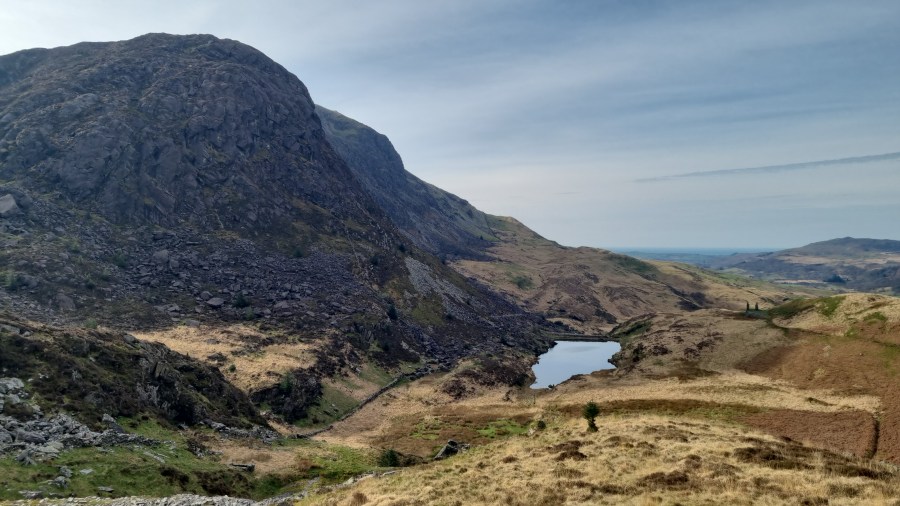
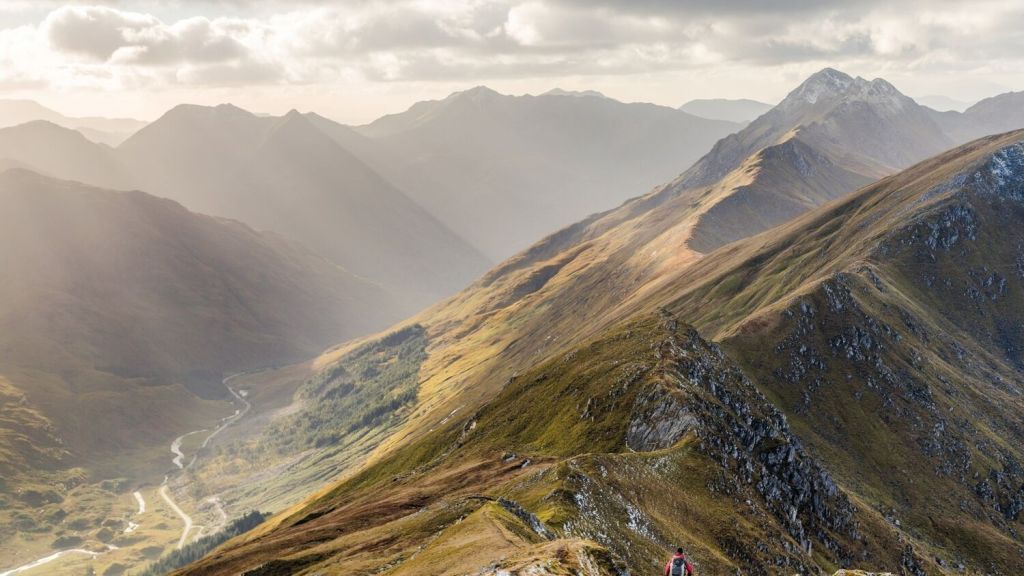
The outdoors has always been — and will always be — a place where I feel in perspective. There’s something about standing on the side of a mountain and flying my drone out into the distance that reminds me just how tiny I am and how massive nature is. I find comfort in that. And my faith tells me that even in this reality of insignificance, I’m important. That I fulfil a role in the world only I can. That the very hairs on my head are numbered.

That same value — that same sacred worth — applies to every single person, regardless of race, religion, or whatever other metric we humans use to divide ourselves.

When I placed all my hope and identity into the military and it didn’t work out — twice — I was left lost. At 16, holding back tears on the train home after failing again, I felt like I’d already blown my life. That failure stayed with me for years. I couldn’t shake the label I’d given myself.

Today, in my 40s, I work part-time in a bar to supplement my small self-employed business. I meet a lot of veterans — and a lot of guys who, like me, carry that same lost feeling. I see people every day who are hurting, putting on brave faces, venting anger about things that aren’t the real issue. Just trying to escape the pain of their own lives.

I live today with a universal love for my fellow humans. But I still struggle. I still have to catch myself when I find my gaze drifting and turning the fairer sex into objects. I’ve developed tools to spot that objectification in my thinking — and to stop it. That’s part of why I believe pornography is such a damaging thing: it robs people of their dignity. It reduces them to parts. It devalues something sacred.

When you start living with a higher view of human value, it becomes hard to stomach what you see on the news. It breaks me to watch what’s happening in the world — the way people are dehumanised, treated as disposable, even as target practice. A rogue military backed by a global arms industry. A Western church that’s lost the plot, baptising nationalism and forgetting Christ.

I still know people in the profession that gave me such a long hangover from my younger years. Life has shown me it’s just a job. And that’s helped me. I’ve got a lot of respect and admiration for the lads who serve — and I still carry a heart for them. But I don’t have to see soldiering as the defining measure of worth anymore.

Today was a quiet day at work. No shouting, no angry old blokes ranting about women pundits in sport or refugees in boats — just a young recruit chatting with me about drones and emerging tech. As the conversation drifted, we touched on AI, facial recognition, and drone warfare — specifically quadcopters carrying munitions capable of precision strikes in urban environments.

And then it hit me.

The British military are procuring and acquiring weapons systems based on how they’ve performed on real people in real theatres of war. These technologies are developed, refined, and tested — in places like Gaza — and then brought into service. It’s not just theory or simulation. It’s real-life results… on human lives.

I felt physically sick. To think that the profession I once idealised is now so entwined with this kind of complicity. But I can’t get too self-righteous — because I too have dehumanised others in my life. I’ve consumed people. Turned them into disposable visuals. That history still carries shame for me.

Politics has always been a trigger. But even with my baggage — even with the mistakes I’ve made — I can’t ignore the feeling that we’re heading toward a point where society will look back in horror at what we allowed. At what we ignored. At how we looked the other way.

I’ve always come from the dissenting left. As a Welsh family, we were Labour through and through — the old, working-class, union kind. I’ve worn a keffiah for years, and even during my time as a reservist, I struggled with the casualness I encountered when it came to the militaries attitude to taking lives.

I’m sharing all this because, over the last few years in recovery, I’ve been quiet. I didn’t want to rock the boat. I felt like my opinions didn’t count because of who I’d been — like I had no right to speak. But that’s shame talking. And I don’t want to live out of shame anymore.

That doesn’t mean becoming a crusader or a moralist. I don’t need to preach at anyone. But I do live in a society. My vote counts just like everyone else’s. And I no longer want to avoid difficult conversations or look the other way when something is wrong.

So, maybe this is me reconnecting with politics — not as a source of anger, but as a response to love. Maybe it doesn’t have to be a trigger anymore.

Maybe, just maybe, I’ve just found peace in the idea of significant insignificance again.

“We have been silent witnesses of evil deeds. We have been drenched by many storms. We have learned the art of equivocation and pretense… Are we still of any use?”

—Dietrich Bonhoeffer, After Ten Years
Unpacking the subconscious

The dream is a little hidden door in the innermost and most secret recesses of the soul

Carl Jung

A night of heavy dreaming left me more tired than before. Yesterday was a busy and emotionally taxing day. Life, in general, is, to be fair, challenging, but such things are beyond our control. All that is within our control is to find peace amidst it.

Owning one’s truth can be difficult to live with, and sometimes that means living with the knowledge that others are aware of your most shameful times. I am living in a perpetual state of Step nine (striving to make amends) and will continue to do so for the remainder of my time.

Now that we have some context of where my head is at, I want to unpack my dreams. Some people believe that dreams have spiritual significance, harking back to ancient times. Dreams are like our subconscious minds showing us things, and if we are willing to explore them, they can help settle certain emotional states.


I dreamt I was with a mix of a couple of ex-girlfriends. I say “girlfriend,” but I now realize that many of my former partners were fellow broken souls searching for something no human could offer. We found in each other respite from our own indiscernible pain.

This beautiful chimera was a blend of everything that excited me about the chaos. The sex I thought was fantastic, but it was devoid of real intimacy because it lacked something truly human. In the dream, I was right back there, feeling desired and enough, but as I often failed to see with such partners, completely disposable.

My dream then shifted to show me something painful—a loved one in a hospital bed. I’ve come to love this person as we walked shoulder to shoulder, and I feel I have, in a tangible earthly way, someone whom God uses to show up for me and let me know I am not alone.

In real life, this is a wonderful friend and journeyman, but in my dream, this person represented my fear of loss. When you open yourself up in a truly human way, you have to embrace the risk of loss, hurt, and all the pain that might come with it. It’s how we truly get to live—by embracing the full spectrum of life and not being selective.

I experienced this feeling and fear when I fell in love with my puppy. She won’t be around forever, and one day will come great pain and loss. But in between, all the colorful joys that come with it, there’s limitless love and acceptance.


Back to the dream, I let the girl walk away, and true to my experiences, she moved on relatively quickly. But this time, I didn’t dwell or jump to the next with a ball of emotions thinking, “next, next.”

I then took a call from a friend. A friend who said, “I know what’s going on, mate, and you’re not alone. I know you’re more than what you’ve done, and I’ve seen day in and day out for years now what you’ve done to make amends. You spread more life now than you ever peeked at death.”

This friend represented hope, hope that I will be seen not through the prism of my worst actions but rather through my authentic life in colour.


As I lay here thinking, I have a day to get on with, and I conclude from this busy night of dreams, I see the important lesson. Acting out or using others to medicate feeds one another’s pain for a moment, yielding nothing because it risks nothing emotional, sure, you can take risks that wreak havoc in life but we addicts throw that dice every time. This stuff is deeper than addiction.

When we love, we have to be willing to experience it all—the good, the bad, all weathers, and even loss.

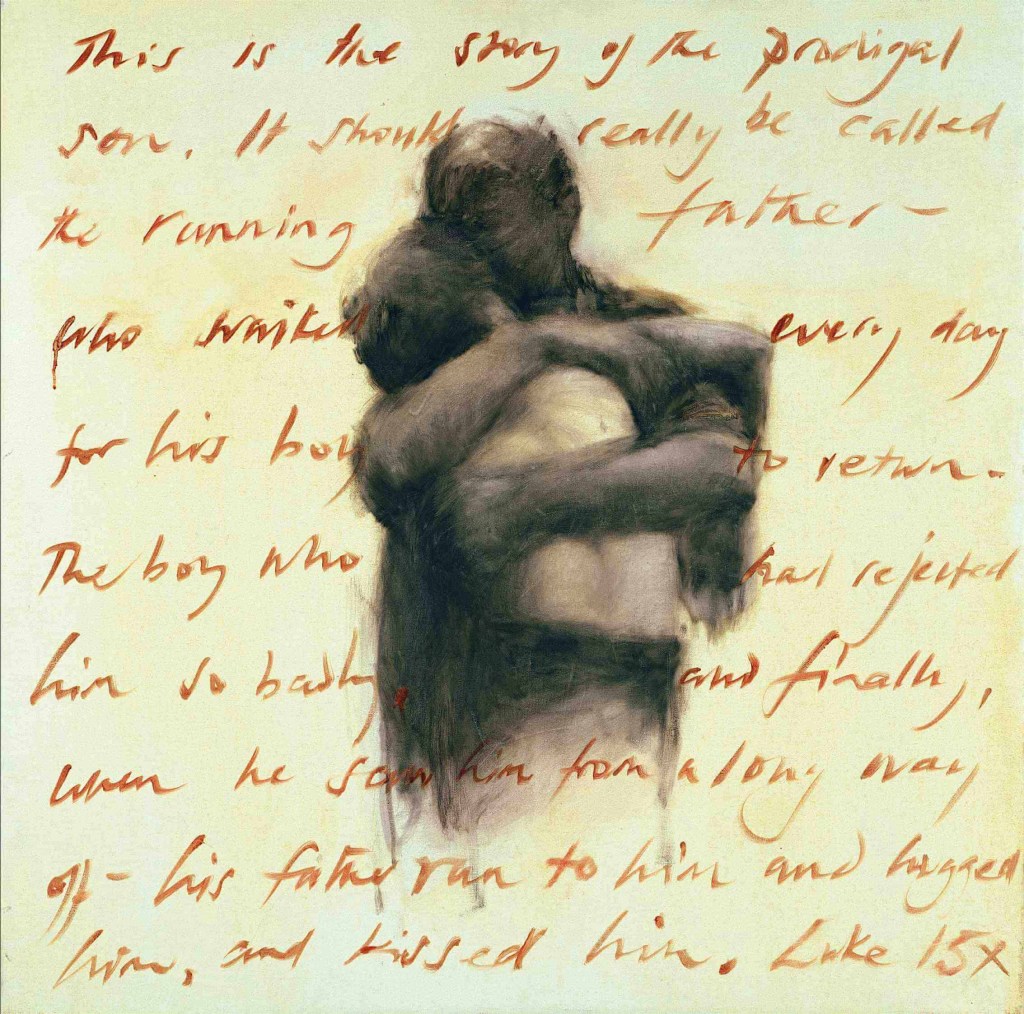
When I traveled out of my mess, I was like the prodigal son Jesus spoke of. I was truly spent, broken, and my choice was mud, death, or redemption. I may or may not be forgiven in men’s eyes, but if I make myself a servant, it will be better than the mess I made. True to the story, while it is not without cost, I am restored, I have worth, and I am accepted.

There are no “real” relationships without this risk, and the only fee is to be open. The world offers counterfeit love, so I have to wonder why I spent so long with my microwave meal when I now get to experience the Father’s banquet.

Letting Go Absolutely

Almost 2 years into this and I have still a lot of work to do with surrendering my will and trusting my power greater than myself with my future, my addiction is like a soundboard that’s there with its distorted thinking and well-worn tropes about women, sex and pornography, which always seems to pipe up like that pissed up uncle at a wedding with no verbal filter.

For so much of my life things have always felt out of control and stressful, my childhood was traumatic, my adulthood stunted and riddled with emotional hurt and the loss of a baby to a rare condition led to me boxing up all hurts and toughening up just like people said I should, life then became a projection, a managed press release of who I was and social media made it easier to live this way.

In the throws of all that life has sent my way the only thing in life that made me feel like I could handle the ups and downs was the ability to regulate, albeit in a very unhealthy way, I mean how could I have possibly thought that compulsive masturbation mixed with full night binges surfing limitless pornography was a normal or healthy thing to do.

Sun rises were not moments to be present and grateful, more disgusted, tired, and ashamed that I had spent yet another night secretly digging around the digital highway before forcing me to go sleep ready for another day of work, the double life of an addict means you eat, sleep and breathe with contradictions.

There’s a part of the Alcoholics Anonymous big book that says this:

“Some of us have tried to hold on to our old ideas and the result was nil until we let go absolutely”.

That’s the challenge that I have to embrace everyday, to let go absolutely, there is a but here though, I feel, there is never a final victory or a final defeat for an addict. I may be a little pessimistic here but I feel it’s being grounded in humility to admit that this stuff is just too “cunning, baffling and powerful”

I must admit it often feels likes groundhog day but this is no comedy and I’m not Bill Murray.

For now, letting go absolutely, looks like handing over control of my privacy when it comes to the internet, it’s saying I cannot be trusted to drive myself, all of my best efforts landed me in a right mess.

Accountability is both a consequence and a rescuer to me. My devices are all kept safe using Covenant Eyes and along with the 12 Steps and therapy it has been a vital tool for me to coexist with modernity.

It’s been a trial and improvement journey to adopt and embrace the laying down of my “rights” to safeguard myself from the poison of the “world wide vine”.

Today I am grateful that my devices are monitored and my sponsor gets a daily report of my usage, it can be funny at times with what sets off the explicit alerts but I am glad to have the boundaries.

When I sit in my plastic chair each week I know I am not alone in this struggle, I often feel incompatible with the technological age we live it, it has been like a coercive drug dealer and now in recovery is a tool for me to spread hope and awareness.

I know that behind me are scores of future fellows so when it gets tough I have to remind myself it isn’t all about me, my experience can be someone else’s hope in their darkest hole, and that is why I have to choose to let go absolutely, every sunrise, sunset and through the night until the daylight shows up once more.

All things in moderation

I really feel an overwhelming sense of gratitude tonight for the program and the fellowship, I shared tonight about how I feel at times, that I step back into the ring with myself and it feels a lot like the old days. As I shared it dawned on me that my “acting in” can have a dual aspect to it, I rely heavily on looking at myself and reflecting on things but sometimes spending time alone with the mirror can get dark. My language was that of struggle and in reality, serenity is peace in the waves so the “room” was pointing out something to me tonight that helps me to correct my compass.

So we know what acting out is, so let’s look at acting in, what is it?

Acting in is a concept in addiction recovery that refers to turning one’s attention inward and focusing on inner experiences, thoughts, and emotions. It is a process of self-reflection and self-awareness that can help individuals identify triggers and patterns of behaviour related to addiction, as well as develop coping skills and strategies to manage cravings and urges.

Acting in involves a deliberate effort to cultivate mindfulness and presence in the moment, as well as an acceptance of one’s internal experiences without judgment or avoidance. This can be challenging, as individuals in addiction recovery often have a history of numbing or avoiding emotions and experiences through engaging in addictive behaviours.

By practising acting in, individuals can learn to identify and address underlying emotional and psychological issues that may contribute to addiction, such as anxiety, depression, trauma, or low self-esteem. It can also help individuals develop a greater sense of self-awareness and self-compassion, which can be instrumental in the recovery process.

Some common techniques for practising acting in, in addiction recovery include meditation, journaling, art therapy, and cognitive-behavioural therapy (CBT). These techniques can help individuals develop greater self-awareness and mindfulness, as well as provide an outlet for expressing and processing difficult emotions and experiences.

While acting in can be a positive and helpful approach to addiction recovery, it can also have negative consequences if it is taken too far or used inappropriately. Here are some ways that acting in can be negative:

  1. Avoidance: One of the risks of acting in is that it can become a way of avoiding difficult emotions or situations. While it is important to be aware of and process internal experiences, it is equally important to engage with the outside world and face challenges and stressors head-on. If acting in becomes a way of avoiding or numbing emotions, it can hinder rather than facilitate recovery.
  2. Isolation: Another risk of acting in is that it can lead to isolation and social withdrawal. While it is important to cultivate self-awareness and introspection, it is equally important to maintain social connections and support networks. Isolation can lead to feelings of loneliness and despair, which can contribute to relapse.
  3. Rumination: When individuals engage in acting in, they may spend a lot of time analyzing and dissecting their thoughts and emotions. While this can be helpful in moderation, excessive rumination can lead to a negative spiral of negative self-talk and obsessive thinking. This can increase feelings of anxiety and depression, which can also contribute to relapse.
  4. Lack of action: Acting in can sometimes be seen as a substitute for action or change. While it is important to be self-aware and reflective, it is equally important to take concrete steps towards recovery, such as seeking treatment, engaging in healthy activities, and building a support system.

While acting in can be a helpful approach to addiction recovery, it is important to use it in moderation and in conjunction with other strategies. Balancing my acting in with my connection to others is a key aspect of addiction recovery. By cultivating social connections and seeking support from others, individuals in addiction recovery can enhance their overall well-being and increase their chances of achieving lasting recovery.

To put it simply, reaching out to others has to accompany my routine of self-care, it’s why calls are so important to 12 Steppers, today was a great day, I had about 5 calls, a meeting and did a bit of service purchasing as my role requires.

Here’s to serenity and peace within the noise, remembering one day at a time and don’t go it alone.

Here’s a song I can’t get out of my head

The Roots of this Tree

I returned home from an Easter adventure, going away these days is really special to me and coming back even more so.

I spent some time with a close friend and made a new friend in the process, there is something about being with others in the outdoors that transcends our background, standing, class, wealth and just about anything else you can think of that normally makes people different.

As we walked up the mountain taking small steps we seemed to take turns with who was leading the way.

I live in a flat area and my local national park offers some modest hills and one or two that just about qualify as mountains in name only. These proper mountains however are always a reminder that I don’t have the legs I think I have and I have some way to go before my coastal marathon.

The escape from modernity is always a small but regular required dose of medicine for me, it’s how I manage stress in a much healthier way than I did with my sexual compulsivity.

Along with this temporary environment hack is the shared experience in the presence of others. I have a great time on my own when camping and hiking but its much more memorable and rewarding when experienced with others.

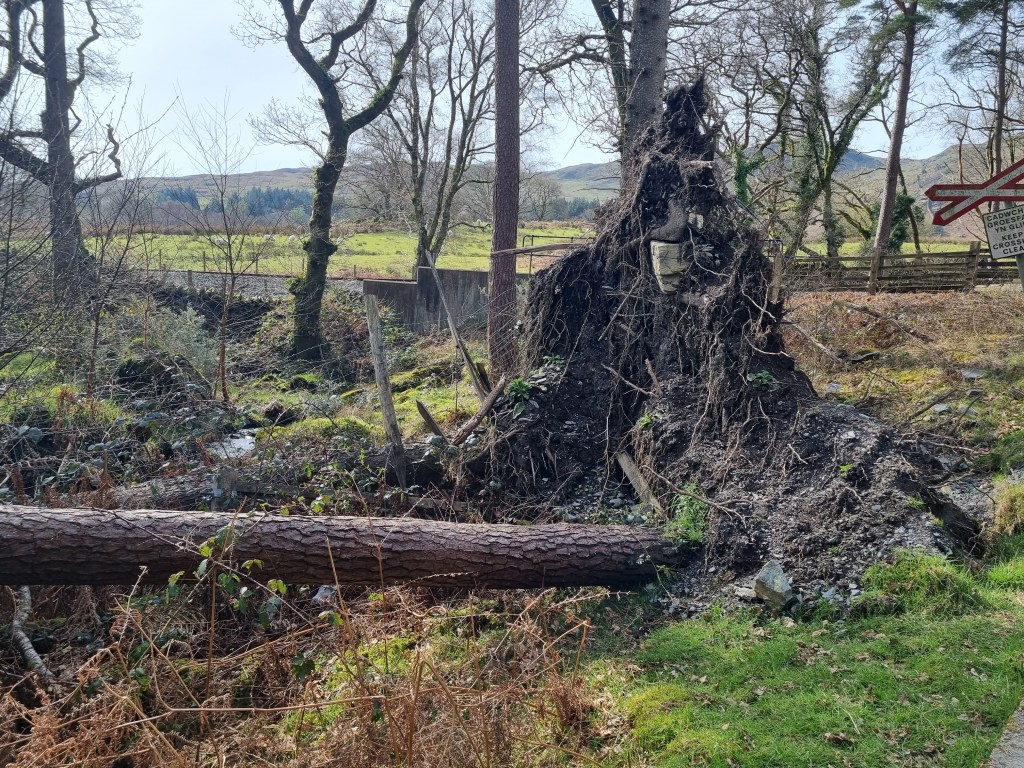
On the way back to a small and beautiful village I spied this tree, it’s image caused me to linger and a thought process was sparked.

Seeing the exposed root system of a tree and the scar of the earth when a tree is uprooted is quite a sight, much like my life over the last couple of years. The initial storm uprooted me and I had to accept those roots could never take to the ground again.

My sexuality got hijacked at the age of twelve, I came into contact with far too much graphic material and with the best part of a quarter of a century later it is of little surprise that I had picked up a lot of unhealthy coping mechanisms, behaviours, obsessions and distorted thinking. The roots had grown deep over the years.

The upset and fallout from coming to terms with my reality has meant there is a hole of time, headspace and priorities that I get to fill with better choices, behaviours and experiences.

Outer circle living is one of the most important parts of my life, in AA we have the script that says “I know I am to get along without acting out, but how am I to do so, do I have a sufficient substitute? Yes and it’s vastly more than that.

If you ask a room full of sex addicts what Penal Substitution means you may get an inappropriate answer but in short its the biblical concept that Jesus provided the atonement for us where we could never measure up under our own endeavours.

While the program is non religious I mention this as the program allows us to admit defeat and face the facts that we will never conquer this problem in one sitting or alone. The concept of a higher power is the foundational tool of recovery.

The program can seem a little cult like from a set of new eyes or those of an outsider. I often refer back to the concept that regardless of religious belief or any hangups about the G word that sex and pornography was my God, I was faithful and devoted in my worship to this false deity, I served earnestly and I diligently sought out the iconography associated with my life of secret rituals and sacrifice of dignity and self worth.

I guess that’s the point, addictions are spiritual illnesses or maladies, they are misplaced worship of powers greater than ourselves, we simply find in our quest for our higher power in recovery a substitution for our worn-out false gods.

In the place of the uprooted tree, I hope that I may continue in this journey of healthy spirituality, no churches, no pulpits and no pretence. Just a desire to connect and to serve my fellow man in the endeavour of a life free of our addictions.

I used to listen to this song called rootless tree, it feels like it’s taken on new meaning to me in recent times, it seems to capture the voice that was always crying out to be free.

Recovery is breaking up from the toxic relationship with myself, the abusive and destructive voice constantly saying I was never good enough, and the gravity of the secrecy that enslaved and incarcerated me for years no longer has the same power it once had.

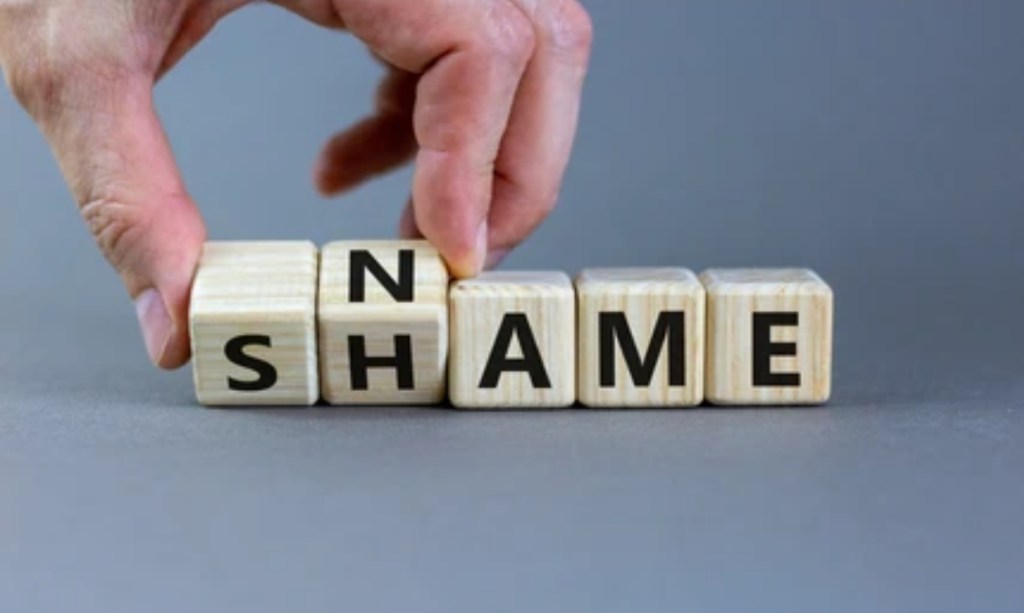
Shame in a name?

I’ve been called Adam, Aaron even Nick. It’s part of life, I know what it’s like remembering people’s names. It takes a while to etch them to memory and it isn’t personal.

It’s perfectly reasonable to correct people on something like this. But I haven’t, I wonder why that is.

Honestly, I think being the grey man is a survival instinct these days.

It’s been niggling me for weeks, I can’t shake this feeling of toxic regret and shame and my name seems to be a trigger. Every letter and phone call seems to make me wince a little.

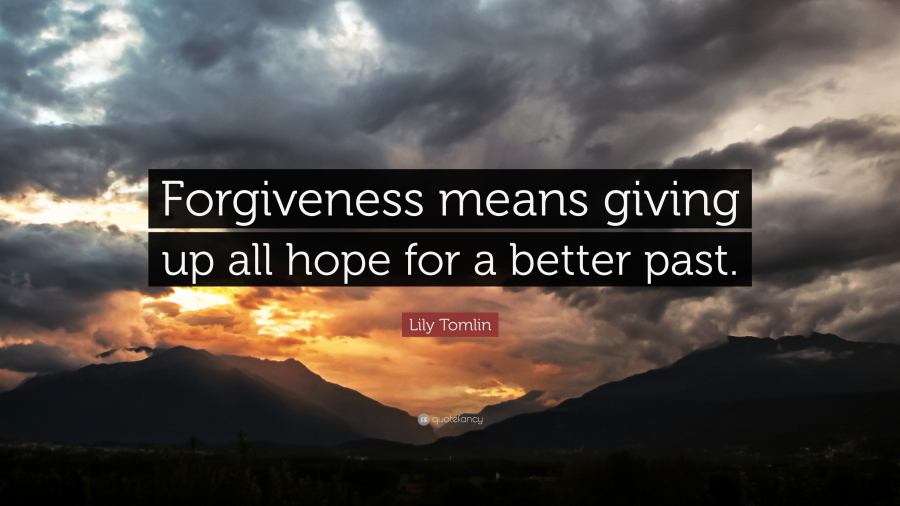
I’m still angry at myself. I know the me of now is far different to the “few me’s ago”. Life evolves, we change and to define myself by the past is to willingly and knowingly place myself under shame.

I recently heard one of these online self-help soundbite gurus on a reel clip talk about how not correcting people when they get your name wrong means you don’t value yourself. Perhaps there’s some truth to this.

My thoughts are drawn to biblical figures who are renamed by God, Saul the persecutor became Paul the leader, and Simon the fisherman became Peter the rock.

The lesson here is not so much in the names and the meanings but more that they represent the death of the former and the life and new birth that follows. Out with the old and in with the new.

The phrase dying to self is a religious one but in my recovery its an important priority in my life, my own way leads to destruction and oblivion. By putting my ways to death it creates space, time and opportunity to be present and show up in my life.

The process of that death that gives life is what my self-care looks like. I guess what I wrestle with is that my name represents a stunted, flawed and broken individual and I am still trying to make peace with that past without avoiding ownership and accountability.

While walking with my partner today she jokingly said I’m tired so I’m going to sleep, we happened to be on a hike with a little bit further to go, she closed her eyes as I held her hand and carried on walking and thought I was going to lead her in a ditch so she opened her eyes. I laughed and said, the problem isn’t where I will lead you, it’s that you don’t trust me.

This was a bolt of lightning moment for me. It’s exactly what my relationship is with my higher power, letting go of the steering wheel is so hard to do. Coping with life’s stresses with my addictive behaviour was like my vehicle suspension, I thought it was giving me a smooth ride.

I recently met with a fellow addict and we discussed what things were like for us in “the bubble” I used this week’s language of experience, I’ve been playing a video game with my partner, and we each take turns to make our way through the story of the game.

We observed how we both approach the game from a different angle, she explores, solves problems and builds up her inventory and equipment so that she can take on the bosses at various stages. A wise methodology that mirrors her pragmatic and patient approach to life.

On the other hand, I try to go straight to the monsters and try to beat them too soon. The trouble is I roam from one side quest to another and don’t stick to one thing.

I get distracted and take ages to make progress because I am ill-equipped, and not ready for the foes I face. I have the capacity for so many tools to defeat enemies but wonder in with one potion and expect to progress to victory but fail miserably. (Sounds a lot like basic me)

All of a sudden life sounds like a video game, I work on my inventory, and I know that there are many solutions to life’s puzzles, stresses and monsters.

I guess the lesson I take from the shame of one’s name, is a simple one, it’s all about the repetitive act of self-forgiveness.

The disease of choice?

I try to keep my focus on experience, strength and hope but from time to time there is an element of theory that needs exploration to gain a greater understanding.

As far as addictions go, sex addiction carries greater societal shame than its substance and other behavioural counterparts, often inducing outrage when discussed in a cultural setting. Many sex addicts work very hard to live in privacy and live a life of amends and carry the message discreetly, some live under a rock and live in the shadows.

I’ve not been comfortable with the idea of living under a rock, the programs mantra of from shame to grace leads me to focus on the redemptive latter than the former, I try to own my identity as a recovering addict while preserving my anonymity. Shame has to become a healthy boundary keeper rather than a monstrous accusor.

Recently I found myself on a sex addiction subject algorithm rabbit hole. There seems to be an ongoing debate over whether sex addiction is a disease or disorder, a legitimate addiction or a label for individuals of low moral fabric.

While this debate rages on, the real questions should be about the cause and what could be done to remedy the suffering of addicts and those affected by the fallout.

I find myself amazed, thinking why isn’t porn identified for the toxic cancerous industry that it is. Consumers and performers alike are victims on opposite sides of the coin, and a coin is an apt metaphor given the billions it generates every year.

Why are lads in their 20s needing viagra to perform sexually? And why are stats indicating that young people increasingly encounter oral sex before their first kiss? Pornography availability has exploded in the age of broadband and wifi and contributes nothing positive to the human experience.

In the stories of many addicts of all kinds, the common theme in shares, is that they came to their maladapted coping as early as twelve years old, some even before that, The distorted thinking that often finds it’s roots in childhood, leads me to believe that education is a great means of prevention. But how are we to go about better education when the modern day teacher of all things sex is porn, social media, celebrity culture?

As a seasoned veteran consumer of print, VHS, DVD and digital porn, my sexual compulsive behaviour would descend on me like a fog, despite my best efforts to swear off using or keeping things as beige and “normal” as possible, I would be overrun by what I can only describe as brain malware. I was more of a passenger than a driver.

We have the phrase, cunning, baffling and powerful when we remind ourselves of our powerlessness to overcome our addictive behaviour alone, originally coined by the founders of Alcoholics Anonymous in the “Big book” it’s a phrase all twelve steppers will be familiar with, from the gambler who despite all logic creates a financial black hole in their life regardless of the consequence, or the alcoholic who continues to drink after recently being kept alive when organs pack up, only to crack open another crate as soon as they can lift an arm to drink.

We all know that the things we did as addicts living in ignorance of our “disease of choice” only happened because we were not in our right minds, we had no brakes, and the perceived high far outweighed the possible consequence. We existed in contradictions sellotaped together by distorted thinking.

Sex addiction has been joked about, and ridiculed as an excuse for getting caught and I even laughed it off in the past saying “isn’t everyone a sex addict”? The irony was completely lost on me at the time.

South Park mocking sex addiction

The formative years are becoming all the more complex in our culture, making identity, gender, orientation and mental health some sort of human tapestry of dysphoria.

I have to stay away from issues of political and cultural debate as I find them quite depressing and to take care of little old me, I have to live my life in the present. Experiential-based living without getting sucked into the vortex of theoretical arguments that further nothing but divide and segregate us.

It seems that disunity, anger and outrage are currencies that are performing well. While intimacy, empathy and forgiveness are in shorter supply.

While medical professionals disagree with one another over the legitimacy of sexual compulsivity as a bona fide addiction, I thank God for those who choose to work with humans. As a recovering addict, a label or a status of disease isn’t important enough to me, what is important is that I get well and stay well, that I live a life of love, intimacy and authenticity, a life connected to others.

The world seems obsessed with the expression and recognition of the individual.

For me, all of my individual-centric focus landed me in a spiralling existence of shame, stunting and suppressing my authentic self.

In connection to others and dying to self (to use a religious phrase). I find purpose and true empowerment.

I hope that in time people can talk about the things that nobody likes to talk about, and we may then see some positive change in the area of people getting help.

Recently in the rooms of recovery, we read the opening chapter of Dr Patrick Carnes’ book “Out of the shadows” its detailed and gritty examples of how sex addiction destroys the lives of those locked in its orbit, was a difficult read, even for those of us living with the condition. Surely if we are uneasy with this, how much more is the rest of the population?

What may surprise you is that Out of the shadows was written in 1983, the year I was born and long before the internet.

It shows that this is a human condition and the internet is more an accelerant than a cause of this particular fire. I often felt many resentments towards the age of living with so much technology, heaven knows I would never have happened upon half of what I did were it not for high-speed internet with endless avenues and shady sewers to explore.

That being said, the internet isn’t some ethereal entity floating around but more like a supermarket whose shelves get filled with what we find, linger upon, consume, destroy, revisit and create a demand for more.

A disease of choice? As long as I am living out of the shadows, that’s all that matters for now.

Escaping the island

The last week has been full of ups and downs. I found myself grieving the absence of a friend who will be walking a different path. The bond we addicts form in our shared quest towards redemption is a strong one, we know the shame, the regret and the consequence but we also know it’s important to our journey and making amends that we face it head-on. I threw myself into my step work for step eight so as not to dwell on feeling sad.

As I looked at my list of people I have harmed, I was aware that so much of my life has been spent in isolation and fantasy, I was living in an illusion.

It was tough for me to say that I had harmed a load of girls who didn’t even know the imaginative violation I acted out in my mind. I know I had wronged them, and whether I could ever make a direct  amends or not, I felt it important to name them.

I may not have harmed them directly, but I became aware that my porn consumption meant there are so many faces and real lives that I have wronged by blindly consuming content. I could never name them all, so where I can name someone that I feel I have wronged, I will. It’s also a part of making amends to myself.

I felt a great sense of relief completing this step, I will spend the rest of my days paying the debts of my amends to those directly affected by my addiction and it’s recently dawned on me that the 12 steps isn’t just some self help program to me, it’s now a part of my identity and DNA, given the numerous identities I had tried to wear in the past to find acceptance, this is the one that works and helps me to truly survive and show up in my life.

After a meeting with my home group, I grabbed a coffee and we chatted. It was the first time I experienced a new fellow semmingly saw me as a font of recovery knowledge. I guess thats how it works, when we share, we put our experience, strength and hope out there for others to model and carry on their own journeys.

This lad asked me how I get away from the powerful pull of obsession and our acting out rituals. It was a good question and one that I will spend my life trying to answer as that pull will always be there.

I normally explain that the three circles covers this perfectly as our core behaviours are the black hole in the centre of the galaxy that is our life, if we focus so much on living in our middle circle and closely orbit our inner core then the pull remains a constant.

The trick is to spend life in your outer circle as much as possible, that way its gravity loses some of its captivating power over us.

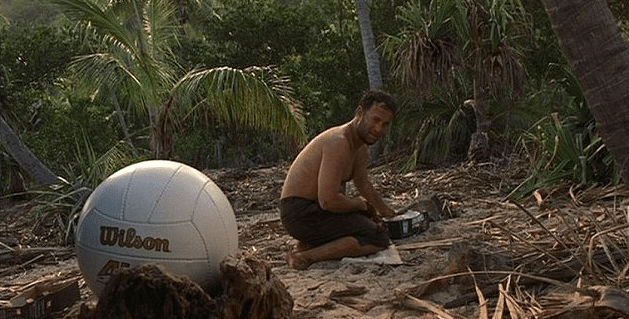
This time though, the medium of film came to mind, my step work left such an imprint on my mind, the realisation of how I had spent life isolating in fantasy. I was lonely on my little island with my imaginary friend. I was like Chuck Nolan in Castaway and my friend that kept me alive or so I thought was my addiction.

I just said, for us to escape our island, we can’t take Wilson with us. He grasped what I was trying to say,

Reaching a place in recovery where you know you have to get off your island is a place where you know you can’t take the illusion with you. Wilson may have kept you alive for a time but it is a one sided conversation, it’s void of real connection. As long as I lived on that island, I didnt show up for life, I wasnt present.

It’s not easy though, because when you have spent so long without real connection and intimacy you often grieve the availability, familiarity and reliability of that one sided imaginary friend. The illusion was real in the bubble but it is so destructive and leads only to more doom.

The power of real connection though is worth waiting for and working to be part of. Intimacy is a two way thing and not really a medicine on tap but rather a moment of intense experience, presence and connection that surpasses anything that fantasy has to offer. You carry the deep love every day with gratitude and contentment in life.

Life will always be about seeing the real question I am trying to answer in those moments of difficulty. Identifying my true needs means I can find the healthy solution and not fall into the warn paths of old thinking.

I will give you an example, I passed an attractive girl as I returned to my car, my brain started the age of trope saying of “what I wouldn’t give for” I stopped mid-thought, this is the stinking thinking I hate and sadly it’s for many just a normal part of being a bloke. For an addict though, that train runs all the way to doom if I choose to board it.

I disrupt my thinking, I get my phone out as I get into my car and I hit record, what’s the correct pattern of thinking here? I mean, what I really wouldn’t give for, is to be more present with my own partner, to find deeper levels of intimacy and experience each other more, I want to get back what years of isolation in my addiction have robbed me of.

That’s the train I chose to board, as I dont ride it alone and drowning in shame.

As trainspotting says “choose your future, choose life”

Steps eight & nine | Consequence, a part of recovery

So here we are, Step 8. It’s time to list those I have harmed and be willing to make amends to them all.

As I look at the growing list of people I have to make amends to in my life I am faced with the consequences of my previous life decisions and the harm caused by my compulsive sexual behaviour.

The thought of how I could make amends to people not even in my life anymore is daunting, what’s more challenging, is the thought that there are countless faces I have objectified and witnessed in my consumption of pornography that I could never name or make amends to.

Living amends

Top of that list is my partner, I never appreciated just how solid, faithful and loving this person has been the whole time, when I think about the fights and the times when I thought we aren’t going to last, not knowing if she really loved me enough in those years. Over the last nearly two years she has been the illustration of what love is. She is everything I ever wanted and she was right here with me the whole time.

I am willing to spend the rest of my life making amends and intend to love her with gratitude and joy that I couldn’t have imagined before.

This journey though is tough, tonight she looked at me and said “you need a hug” the fact that I get to hear words like that after what I have done to her teaches me so much about love and forgiveness.

She has been supportive and empathetic towards my addiction recovery and in ways had been like a sponsor at times. Early on in our relationship, she got me watching Elementary. Crazy to think all these years on and we still watch it and I now identify with all those 12-step scenes like it’s a different show.

Direct amends

There are others I need to make direct amends to, I have or had a friend that stepped away from being friends with me when I told them about my problem, they went through the motions of “we are ok mate” but disappeared from my life without a trace. The silence and absence have been deafening, but that’s a consequence. Direct amends would need to be made as I owed them a sum of money when we parted ways so I need to make that right even if our friendship cannot be repaired.

There are those too, that if I ever saw again and an opportunity arose, I would like to make amends and apologise to them for my conduct in either friendship, employment or with those with whom I displayed sexual or emotionally destructive behaviour. They may or may not be possible but being willing is the key here.

Except when to do so…

The thing about making amends for the past is I may do more harm than good, so it may not be possible to cover every person on my list, they may not be reachable or even alive anymore.

A lot of this stuff I will have to live with so a really important one is to make amends to myself, I devalued and went against my morals and boundaries countless times in my sex addiction. Getting my self-care right and working on my program is how I make my amends to myself. If I get that right I might be around long enough to get through as many of them as possible.

Tonight the phrase “consequence is part of recovery” plays through my head. The key is not to despise it, or fear it. It’s the most important part of the healing process for all parties.

By making amends in whatever shape it takes we demonstrate that we are no longer slaves to the false God of our addiction. For a world that is cynical about higher powers, we sure do have a lot of fake ones out there.

Today has been a triggering day but one where I reached out to others, practised gratitude and prayed for the sex addict who suffers and I always have to remember that man is still me. I face each day by the grace of God and I continue on this journey from Shame to Grace.

While the consequences of my past spread out like ripples on a pond I know the future is a much bigger stone than my past.

I finished the day with meditation and an ice-cold tub. The natural stressor teaches me I can handle discomfort and find serenity in adversity.

As I write this post I am in bed warming up. Grateful for my loved ones, my home and the level of comfort I get to appreciate.

Start with the mirror

In my recovery journey, a blend of therapy and working the steps has led me to a much better place in life, I may not be perfect but that’s ok, I was never meant to be, nor could I be.

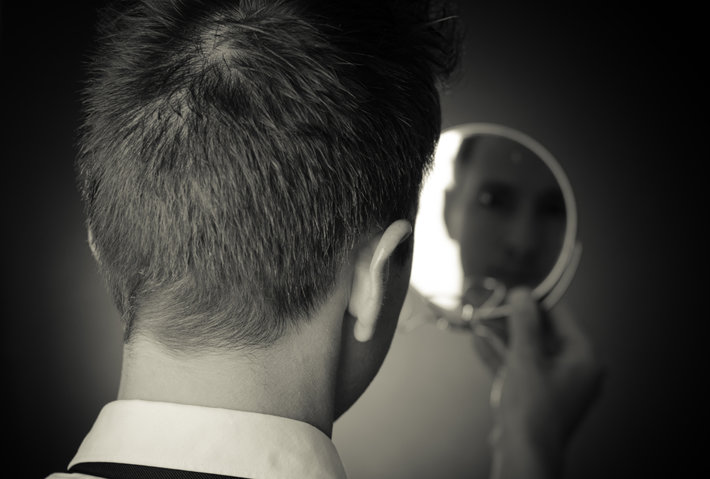
Man looking in the mirror

In some time with a fellow twelve stepper, we talked about service, service is a great part of recovery but for someone with a past in clean yourself-up religion, it can be important to recognise that I don’t get to medicate with work and service at the expense of my self-care.

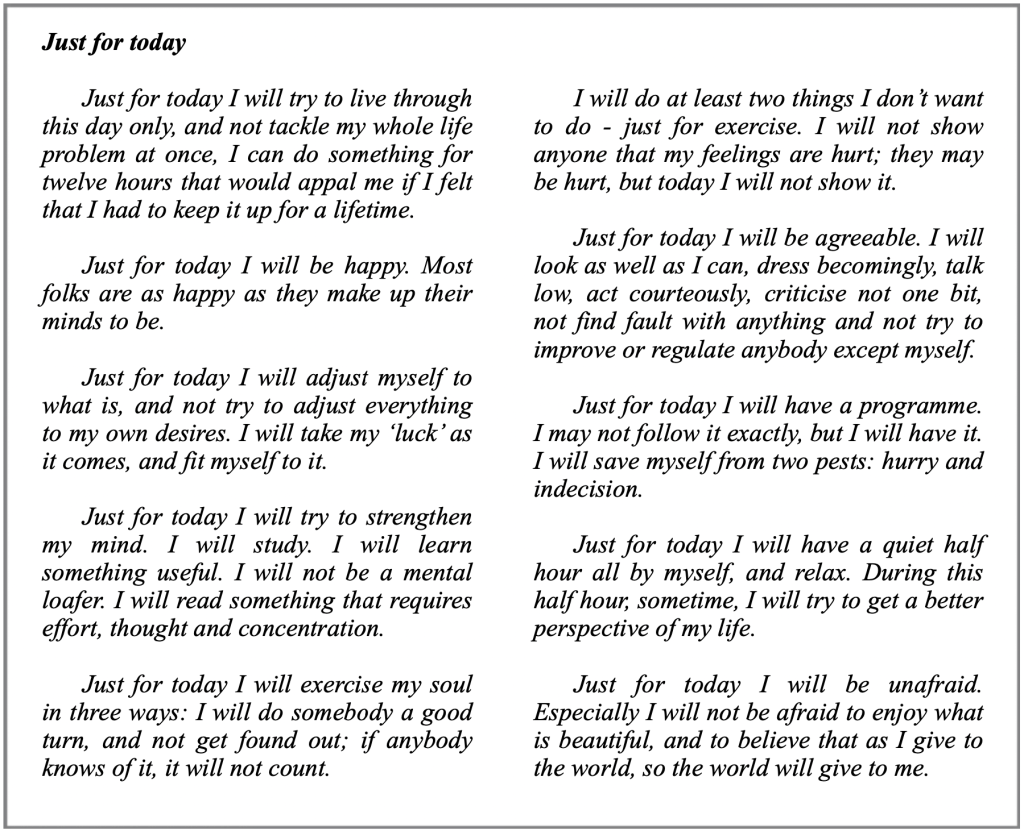
Self-care is a label for many things. In AA we have a thing called Just for Today and it hits on the aspects of practising self-care.

Just for today card of alcoholics anonymous
One of the first tools of recovery

It’s a checklist for getting oneself through a day and keeping one’s sobriety intact.
For recovering addicts, it’s a case of focusing your time management on establishing healthy rituals that keep you out of the prison of your addiction.

In a recent meeting we listened to a main share from an American group that makes recordings available online, I had heard this one a few times but on this occasion, it helped me to realise where I had gone wrong in a scene earlier that day.

I have felt misunderstood most of my life and struggled with healthy attachment and boundaries for a long chunk of that time. While I have made significant leaps in communication and honesty. I know that the answer to my problems is never inward towards myself but in connection with others. I still struggle with the worries of being misunderstood or judged.

In the past, I was always told I was the king of the overshares, something which strikes me as ironic in recovery, as I never really shared the important stuff, rather, I opted to get caught up in conversational theory based on knowledge and subjective opinion.

When you have new colours to paint with in life you have to go through a process of learning, the vulnerability, emotions and empathy can be powerful. In recovery I have found new depths in forgiveness that I didn’t think possible, I realise too that when I open my mouth in conversations with others, I have to start with the mirror.

When you spend time with people you will find differences in opinion, that has always been the case, but we live in a time where our phones are also platforms, and the internet becomes a supermarket that gives you more of what you look at, click on, buy, consume, watch and listen to, (you get the point)

This isn’t just an image applicable to my use of technology and a cautionary tale of being careful about what you look at, but also how you spend your time, who you hang with and who you listen to.

We all have one of those friends that like to gossip, dump their opinions about everything or keep on going into awkward territory when you spend time in their company. I have been and can still be a person like that.

I recently found myself courting some old behaviour patterns, in today’s cancel culture it’s easy to feel disheartened and fear that we as a society have become unforgiving and offer little chance for redemption for anyone.

We live in a time where anger is a currency and the marketplace is massive. The only thing is, it has no value. Outrage and viral reactions amass comments but contribute little else to discourse or understanding.

In the past, I would get drawn into political discussions and theoretical rabbit holes to escape or hide from my problems, it was how I unknowingly tried to manage others’ perceptions of me, it was a sideshow, a distraction that meant I never looked in the mirror and felt the pain.

So I found myself getting defensive in a conversation where I knew there would be a contentious difference of opinion, despite knowing that nothing good comes from being triggered into trying to justify, rationalise and explain my opinions when it just wasn’t needed.

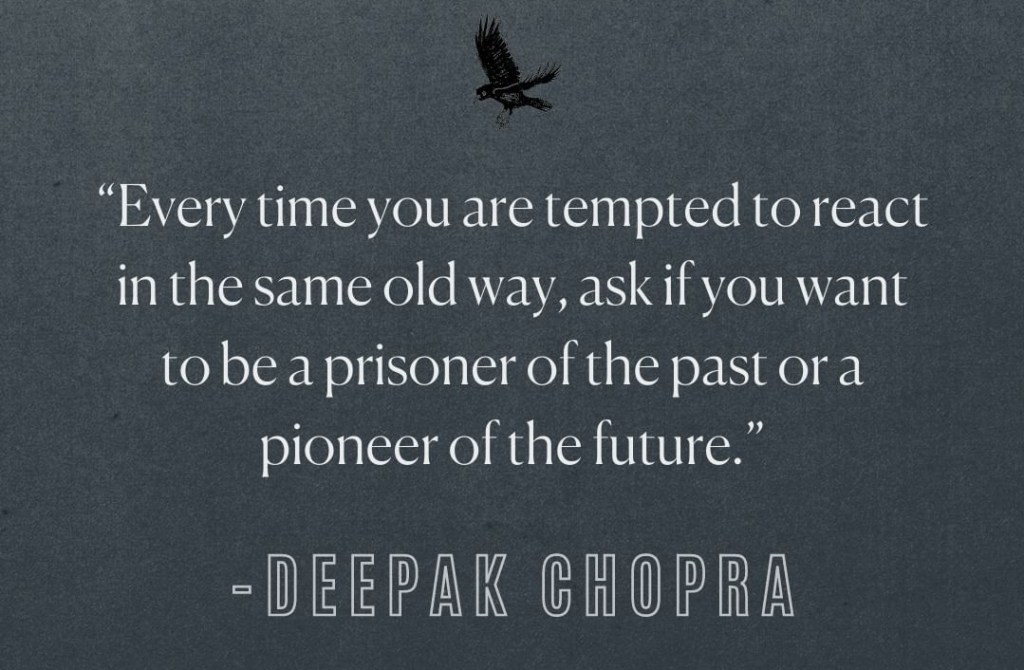
Deepak Chopra Quote

In reflection and meditating on this, I am inclined to wonder is there a Sex Addicts version of being a dry drunk?

A dry drunk is an AA term for an alcoholic that is sober but displays the same behaviours as when they were drinking. The answer in my case is yes there is and I need to have my eyes open.

The sharer in the audio I previously mentioned explained that he had spent his life not feeling good enough, he would often try to figure out what was wrong with others and try to fix them meanwhile neglecting his own needs.

I identified with that a lot, I mean I did that a lot, growing up, and it would manifest in trying to figure out why my stepdad would be so moody, was it me? Should I do something? Make a cup of tea maybe? I carried on this people-pleasing behaviour. Even in my relationship, I have a habit of sorry bombing, I would try to defuse tension by apologising for things I hadn’t done, so much so my partner would say “What are you specifically saying sorry for?”

My relationships and my time have to be built on my new life and genuine self, they have to focus on the related part of the word relationship, there cannot be room for performance or me trying to manage other people’s thinking or perception.

The last month or so has been tough, while I am grateful to be intact and sexually sober and for the most part, working my program well, I must confess that I can neglect self-care, maybe not in the dress or personal hygiene sense, but when I engage in conversations that make me vulnerable, I neglect my self-care practice of privacy, I drop the ball. Or as my therapist helped me to see, I allowed someone to get me bent out of shape.

When I am overtired my mind gets very active, I can waffle on at my partner despite seeing her eyes check out to get some sleep. I guess when I get tired of life I need to be on guard against baseline behaviours and thinking, even if they are not directly related to my core addictive behaviours.

I also realise that my morning routine needs to be better, facing the day alert and calibrated to my just for today means I have a better day than if I just roll out of bed and try to tackle things as they happen. It starts with surrender, and a reminder in the mirror each day that my only job is to take care of me. I can help others but it isn’t my job to please, fix or convince.

The David Goggins book “Can’t Hurt Me” has helped me a lot with my journey out of the pit.