
Stuck in the middle with me

“My advice is, never do to-morrow what you can do today. Procrastination is the thief of time. Collar him!” — Charles Dickens  

Anyone working the steps with SAA will know the terms inner circle, outer circle, and middle circle. It’s one of the first exercises in recovery—but this isn’t a post about defining the circles.

This is more about what long-term recovery actually looks like. I’ve been on this path for over four years now, and while I’d love to say I’m living in full serenity and the outer circle all the time, that would be insincere. Recovery takes honesty, and the truth is, I spend a fair bit of time in the middle circle.

Each person in SAA defines their own abstinence, but if we’re not careful, those definitions can turn into a game of musical chairs. The inner circle behaviours are usually the obvious destructive ones that caused the crisis that brought us into the rooms in the first place.

But the middle circle—that’s the messy in-between. These are the mind states and lifestyle patterns that don’t look like outright destruction but still pull us away from presence and connection. Life is full of responsibilities and distractions, and while distraction itself isn’t always bad, it can easily become destructive if we don’t have a foundation of support—through God, community, or honest relationships.

For me, the world is saturated with distractions. Political noise, religious arguments, artificial intelligence, endless short-form videos—scrolling a social feed alone can be enough to depress anyone or drag them into a rabbit hole. The best advice? Pause, and switch course.

I regularly prune my feeds, hitting the three dots and selecting “not interested.” It’s part of staying a healthy human as much as it is about recovery from pornography. My phone greys out most apps at midnight until 8 a.m., but I still find myself burning through my screen time allowance long before the cut-off.

Sometimes I binge YouTube all day, procrastinating on things that actually matter. I may not be a gamer, but I can be just as avoidant.

The middle circle is, for me, often about life avoidance. I can lose hours doom-scrolling political misery or watching other people’s adventures instead of making my own. Even bingeing podcasts and recovery content can keep me from actually showing up in my own life.

Sexually, the middle circle often means navigating solo behaviours. These are awkward but necessary conversations—whether with a sponsor, a friend, or my partner. With my partner, we talk openly about what’s healthy: frequency of masturbation, what fantasies are grounded in reality.

Privacy in my sexual life once bound me in secrecy, shame, and isolation. Now, it’s about honesty. The healthiest place for sex is with my partner, in the outer circle, and that’s a two-way street.

From time to time, I catch myself doom-scrolling into subtle objectification. I tell myself, “I’ll just follow that account—it’s harmless.” But fantasy has to stay grounded in reality. Having a tent in my pants over my partner is fine. Inviting Hollywood actresses to the party? That’s just mixing a stronger cocktail for my little pants party and that’s not something I want to be normalising.

The middle circle is where boundaries get nudged. That’s where Step Ten—and plain common sense—kick in. Reflect, check your thinking, and keep the lights on. Secrecy always alienated me, so I choose to live openly.

I also try to go first in these conversations with the men I co-sponsor. Recovery isn’t hierarchical; we walk side by side. Recently I shared about buying a male sex toy, just to experiment with sensation rather than the lifetime reliance on visual arousal. I use humour in those conversations to take the heat out of it, because these are things worth talking about.

The middle circle isn’t a campsite—it’s a crossing. And it’s always best crossed in company, through honest conversation with a friend.

Because recovery isn’t just about what we’re recovering from. It’s about what we’re recovering to.
Toxic Virtuosity

“If you want peace, you don’t talk to your friends. You talk to your enemies.” — Desmond Tutu

I come from the dissenting left. Not the Instagram left or the Twitter hashtag left, but the historic, working-class, trade union labour movement — the left of picket lines, miners’ strikes, and the Tolpuddle Martyrs. The left that fought for the vote, for wages, for dignity. That strand of British politics has always been rooted in the simple conviction that the wealth of our economy should be distributed among all levels of society, and that ordinary people should have the freedom to live without being hemmed in, blocked, or diminished by systems of exploitation.

That’s the DNA I inherited. And when I left evangelicalism, I found myself drawn into that heritage through the writings of Tony Benn. Benn connected me with a new sense of identity. Politics, for me, became what faith had been: a moral compass, a cause greater than myself, something to believe in and to fight for.

But here’s the truth: politics became my new religion.

Around the time of Brexit, through to the 2019 election, I threw myself into left-wing politics with a kind of religious zeal. I was radically enthused, mobilised, and consumed by it. Looking back, it was unhealthy.

At the time, I was still in my addiction, still living with deep fractures between who I was in public and who I was in private. Politics gave me a new mask to wear. In public, I projected a virtuous version of myself: righteous, loud, uncompromising. I found others who projected the same noise, and together we created what looked like a new kind of church.

But inside, in the mirror, I was suffering. Alone, I was broken, caught up in secrecy and shame. Politics gave me a pulpit and an audience, but it was all a performance.

Today I approach politics through a very different lens: the lens of my own recovery and faith. When I discuss principles, I begin with humility. I begin with the awareness that I am flawed, limited, and imperfect.

And it’s that humility that seems to have disappeared from politics. In its place, we see something else: what I call toxic virtuosity.

Virtuosity in this context should mean performed with excellence, virtuousness meaning having moral integrity, and courage. But toxic virtuosity is when the pursuit of the moral high ground becomes poisonous. When virtue is no longer about justice or compassion, but about projection — an eloquent performance of righteousness that actually dehumanises the opponent.

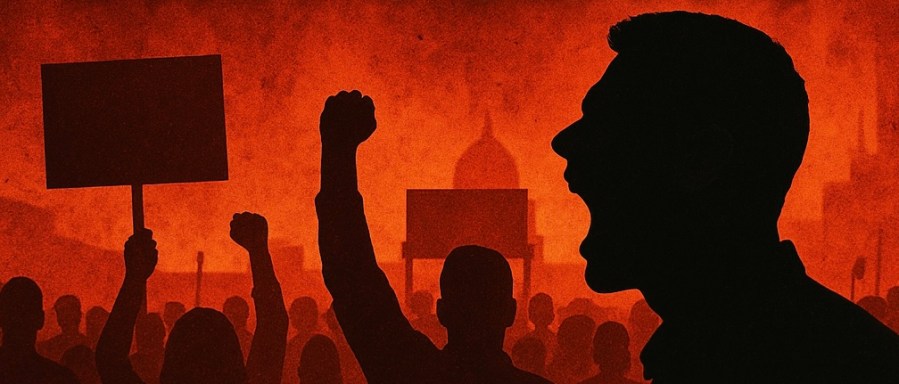
We see it in the way algorithms reward outrage. The louder you shout, the more you’re seen. The more uncompromising you appear, the more virtuous you look. Outrage has become currency in the attention economy, and politics has been reduced to the theatre of moral performance.

A case in point: The assassination of Charlie Kirk.

Now, let me be clear: I probably disagreed with Kirk on virtually everything. Theologically, politically, socially, we would not have shared common ground. I don’t think we would have even agreed on what the gospel is.

And yet, in the wake of his murder, what I saw on the left disturbed me more deeply than the reaction of the right.

People were celebrating. People mocking. People are revelling in his death. And these weren’t fringe voices; many were people who would otherwise claim to represent compassion, equality, and humanity.

The mask slipped. The virtuous facade revealed itself as toxic.

Because in that moment, it wasn’t about theology or politics or ideology. It was about a man — a father, a husband — brutally killed. A family left behind. And instead of lament, we saw glee.

That’s not virtue. That’s poison.

Step back and you see the same dehumanisation at a global level.

We live in a time when war economies drive political systems more than human lives do. Where presidents can hoodwink whole movements — including Western evangelicalism — into becoming cheerleaders for atrocities. Where Zionism is sanctified, and suffering neighbours are demonised. Where genocide plays out on our screens, and the response is hashtags and tribal slogans.

Politics has always been about power. But it was also once about consensus, about the building of a common good. Now it is about platforms of influence, outrage and algorithms. And the result? Othering, labelling, hatred, vitriol, threats, violence, assassination, murder.

This isn’t a left thing or a right thing. This is a human thing.

So what does it mean to bring humanity back into politics?

For me, it begins with humility. By recognising that I am not virtuous in myself. That I am flawed, and so are you. That politics should never be about masking our brokenness with outrage, but about meeting one another as human beings first.

When politics forgets to be human, it becomes toxic.

The answer isn’t to abandon principle. I still hold to the principles of the dissenting left — solidarity, justice, the fair distribution of wealth and power. But those principles must be rooted in humanity, or they become hollow.

There is nothing in mankind that is fully virtuous. We are broken, flawed, selfish, arrogant. And when we forget that, when we build political identities that mask it, we slip into toxic virtuosity.

But there is one. One who embodied humility. One who did not seek a platform but washed feet. One who bore the violence and hatred of politics and empire and yet responded with forgiveness.

The story of Jesus is not just a religious story. It is a story about humanity. A story about reconciliation. A love story that breaks through the toxic virtuosity of human politics.

And I wonder — in an age of wars, assassinations, and outrage — whether that is the story we most need to hear.

The 12 steps and 12 traditions would mean I shy away from commenting on outside issues, but away from the rooms I live in, the outside world.

That world is still suffering, and it needs a message